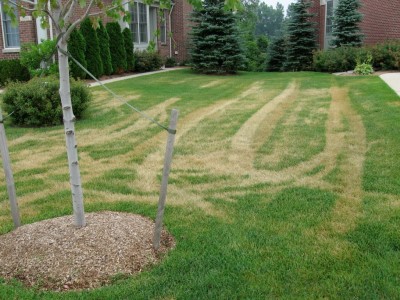
Kevin Frank from MSU writes about the burned tire tracks in lawns. When tire tracks appear in lawns the first assumption is that the machine drove through Round Up or other pesticide and killed the grass. Kevin gives a good explanation of how those tracks occur.
Warm, dry weather causes heat tracking in lawns
Mowers and other repetitive movement can leave tracks on lawns during hot, dry weather.
Posted on August 7, 2015 by Kevin Frank, Michigan State University Extension, Department of Plant, Soil and Microbial Sciences
For most of 2015, rainfall was ample and in many spots excessive in Lower Michigan. The story has been different in northern Michigan with much drier conditions and many unirrigated turf areas entering dormancy to survive while waiting for more favorable moisture conditions. The recent brief hot spell with temperatures in the high 80s and low 90s combined with a lack of precipitation has resulted in many instances of heat tracking damage from equipment.
Heat tracking is damage from any trafficking on turf when it is stressed from high temperatures and lack of water. Often, heat tracking is the result of mowers running over the turf when it is near the wilting point, but damage can result from any traffic, whether it’s equipment or even just enough people walking the same path. Some will misdiagnose tracking damage as being from a pesticide or fertilizer application. The resultant damage may look like Roundup was on the tires of the equipment, but it’s simply from traffic on turf when the turf is near wilting point.
Michigan State University Extension advises the only way to really avoid this damage is to avoid trafficking turf during the hottest time of the day when the turf is under stress. Unfortunately, it is not always easy to tell when this damage is produced. On some days and sites, tracking damage could occur relatively early in the afternoon, and on other sites it may happen later in the afternoon. Mostly it depends on soil moisture and the ability of the plant to cool itself through evapotranspiration. As temperatures rise and soil moisture becomes depleted, the plant will stop transpiring and begin to heat up. This is the time when turf becomes susceptible to tracking damage.
Although heat tracking and wilt damage can look really bad, in almost all cases the damage is not fatal. Temperatures look favorable for recovery in the next week, just make sure the turf has adequate irrigation and doesn’t dry out to ensure recovery.
Dr. Frank’s work is funded in part by MSU’s AgBioResearch.
This article was published by Michigan State University Extension. For more information, visit https://www.canr.msu.edu/outreach/.
If your West Michigan lawn is showing thin strips, heat stress, or worn paths, our lawn care programs can help with watering guidance, fertilization, and recovery. Contact us for a free estimate.
Need Professional Help?
Our experienced team is ready to help you achieve the lawn of your dreams. Contact us today for a free estimate!